
80386
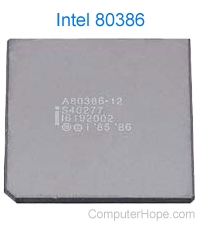
Alternatively called a 386 or the i386, the 80386 is a CPU (central processing unit) developed by Intel. It was introduced in October 1985 as an upgrade to the 80286 processor and stopped production in September 2007.
The initial 80386 was a 32-bit chip that incorporated 275,000 transistors and could perform more than five MIPS (millions of instructions per second). The 80386 sold for $299 and was available in clock speeds between 12 and 40 MHz.
The Intel 80386SX processor was introduced in 1988 as a low-cost alternative to the original 386 processor. The 80386SX lacked a math coprocessor but still featured the 32-bit architecture and built-in multitasking. The chip was available in clock speeds of 16 MHz, 20 MHz, 25 MHz, and 33 MHz.
The 80386DX or 386DX processor was the original 386 processor renamed and not a different 386 processor. Not to be confused with the 80387.
The 80387DX is a mathematical coprocessor created by Intel for their i386 line of CPUs. It permitted the i386 to perform floating-point arithmetic in hardware, improving the calculation speed for those specific operations. The 80387dx was released in 1987, two years after the first i386 processors.
The 80386SL, commonly known as the 386SL, was a version of the Intel 386DX microprocessor first manufactured in 1990 featuring low power consumption and was used mainly in portable computers.
Finally, the 80387 was the math coprocessor used with the Intel 386 processors.
Known issues
Some 386DX 16 MHz Intel processors had a small bug, which appeared as a software problem. The bug occurred when running true 32-bit code in a program such as within OS/2 2.x, Unix/386, or Windows in Enhanced mode. The bug would cause the system to lock up and is a difficult issue to determine without having Intel look at the chip. Chips that passed the test and all subsequent bug-free chips were marked with a double sigma symbol. 386DX chips not marked with either of these symbols may have not been tested by Intel and may be defective.