
80486
Updated: 12/10/2023 by Computer Hope
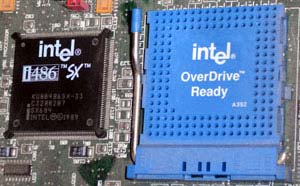
A computer processor developed by Intel as an upgrade to the 386 processor series and commonly called the 486 or i486. The 80486 has 8 k of memory cache built into the processor with 32-bit data bus architecture and was available in clock rates ranging from 20 MHz to 33 MHz. The 486 was available as either a DX or SX, the DX features a built-in coprocessor, the SX does not. A 486 SX2 was also available and was capable of doubling the speed. The picture shows the Intel i486 SX processor with the OverDrive socket.
- In 1990, the 486SL was introduced and utilized less power than the 486 and is mainly used in portable computers.
- On April 1991, Intel released the 890486 SX (code-named P45 and P23) for $258.00 that ran at 16 MHz, 20 MHz, 25 MHz, or 33 MHz, a lower clock speeds than the DX.
- On March 2, 1992, the 486 DX2 (code-named P24 and P24S) was introduced and ran at double the clock rate of a 486. Thus, a DX2 on a system with a 33 MHz bus would run at 66 MHz. Alternatively called the i486 DX2.
- In 1994, the 486 DX4 (code-named P24C and P24CT) was introduced, it tripled the clock rate of the 486 and has doubled the cache (16k). If you had a 33 MHz, it would make it a 100 MHz. Note: there is no 486 SX4.
Note
80486 was featured as a top term of 1990.