
Router
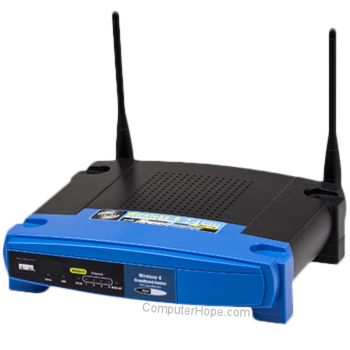
A router is a hardware device designed to receive, analyze, and move incoming packets to another network. It may also be used to convert the packets to another network interface, drop them, and perform other actions relating to a network. Routers are commonly used in home networks to share a single Internet connection between multiple computers. The picture shows the Linksys BEFSR11 wireless router, which resembles the device many users have in their homes.
Capabilities of a router
A router has more capabilities than other network devices, such as a hub or a switch, which can only able to perform basic network functions. For example, a hub can transfer data between computers or network devices but doesn't analyze or do anything with the transferred data. By contrast, routers can analyze the data sent over a network, change how it is packaged, and send it to another network or over a different one.
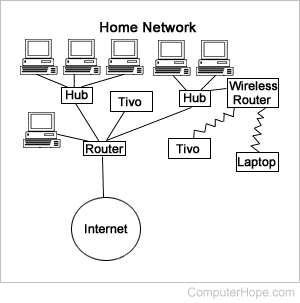
The image above shows a diagram of a home network. In this example, there are different router types: one version is wired, and the other is wireless. The wired router facilitates Internet access for devices using an Ethernet cable. The wireless version allows laptops or other capable devices to connect wirelessly to the home network and access the Internet as well.
Router types
This section contains information about and examples relating to routers used in large networks.
Wireless (Wi-Fi) router
Wireless routers provide Wi-Fi access to smartphones, laptops, and other devices with wireless adapters. Also, they may provide standard Ethernet routing for a small number of wired network devices. Some Wi-Fi routers can act as a combination router and modem, converting an incoming broadband signal from your ISP (Internet service provider).
For more information about wireless routers, see our access point definition.
Brouter
Short for bridge router, a brouter is a networking device that serves as both a bridge and a router.
Core router
A core router is a router in a computer network that routes data within a network, but not between networks.
Edge router
For information on an edge router, see our edge device definition page.
Virtual router
A virtual router is a backup router used in a VRRP (Virtual Router Redundancy Protocol) setup.
How far can a wireless router reach?
The typical range for a wireless router is about 150 feet when the connection is indoors and up to 300 feet outdoors. That said, obstructions such as walls and other objects can reduce the indoor range to 75% of maximum distance or less.
Backbone, Bridge, Computer abbreviations, Hardware terms, Hub, Network terms, Switch