
TCP/IP
Short for transmission control protocol/Internet protocol, TCP/IP is rules (protocols) governing communications among all computers on the Internet. More specifically, TCP/IP dictates how information should be packaged (turned into bundles of information called packets), sent, and received, and how to get to its destination. TCP/IP was developed in 1978 and driven by Bob Kahn and Vint Cerf.
Example of a TCP/IP packet
Below is a visual example of a TCP/IP packet and the information in that packet. Each of the sections of packet are filled with information that help route the packet to its proper destination.
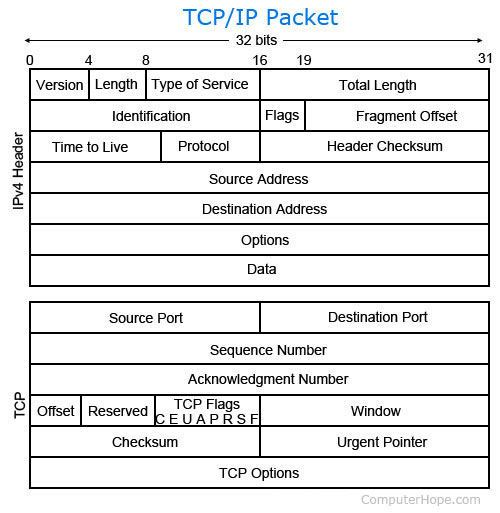
How does TCP/IP work?
As the name implies, TCP/IP is a combination of two separate protocols: TCP (Transmission Control Protocol) and IP (Internet protocol). The Internet Protocol standard dictates the logistics of packets sent over networks; it tells packets where to go and how to get there. IP allows any computer on the Internet to forward a packet to another computer that's one or more intervals closer to the packet's recipient. You can think of it like workers in a line passing boulders from a quarry to a mining cart.
The Transmission Control Protocol is responsible for ensuring the reliable transmission of data across Internet-connected networks. TCP checks packets for errors and submits requests for re-transmissions if any are found.
Three of the most common TCP/IP protocols
- HTTP - Used between a web client and a web server, for non-secure data transmissions. A web client (i.e., Internet browser on a computer) sends a request to a web server to view a web page. The web server receives that request and sends the web page information back to the web client.
- HTTPS - Used between a web client and a web server, for secure data transmissions. HTTPS is used for sending credit card transaction data or private data from a web client (i.e., Internet browser on a computer) to a web server.
- FTP - Used between two or more computers. One computer sends data to or receives data from another computer directly.
Domain names and TCP/IP addresses
The TCP/IP address for a website or web server is not easy to remember. To remedy this issue, a domain name is used instead. For example, 216.58.216.164 is one of the IP address for Google and google.com is the domain name. Using this method, instead of a set of numbers, makes it easier for users to remember Computer Hope's web address.
What are the different layers of TCP/IP?
There are four total layers of TCP/IP protocol, listed below with a brief description.
- Network Access Layer - This layer is concerned with building packets.
- Internet Layer - This layer uses IP (Internet Protocol) to describe how packets are to be delivered.
- Transport Layer - This layer utilizes UDP (User Datagram Protocol) and TCP (Transmission Control Protocol) to ensure the proper transmission of data.
- Application Layer - This layer deals with application network processes. These processes include FTP (File Transfer Protocol), HTTP (HyperText Transfer Protocol), and SMTP (Simple Mail Transfer Protocol).
ARP, Computer acronyms, DNS, Ethernet, FTP, IP, IPX/SPX, NetBEUI, Network interface, Network terms, Port, TCP, UDP