
Motherboard
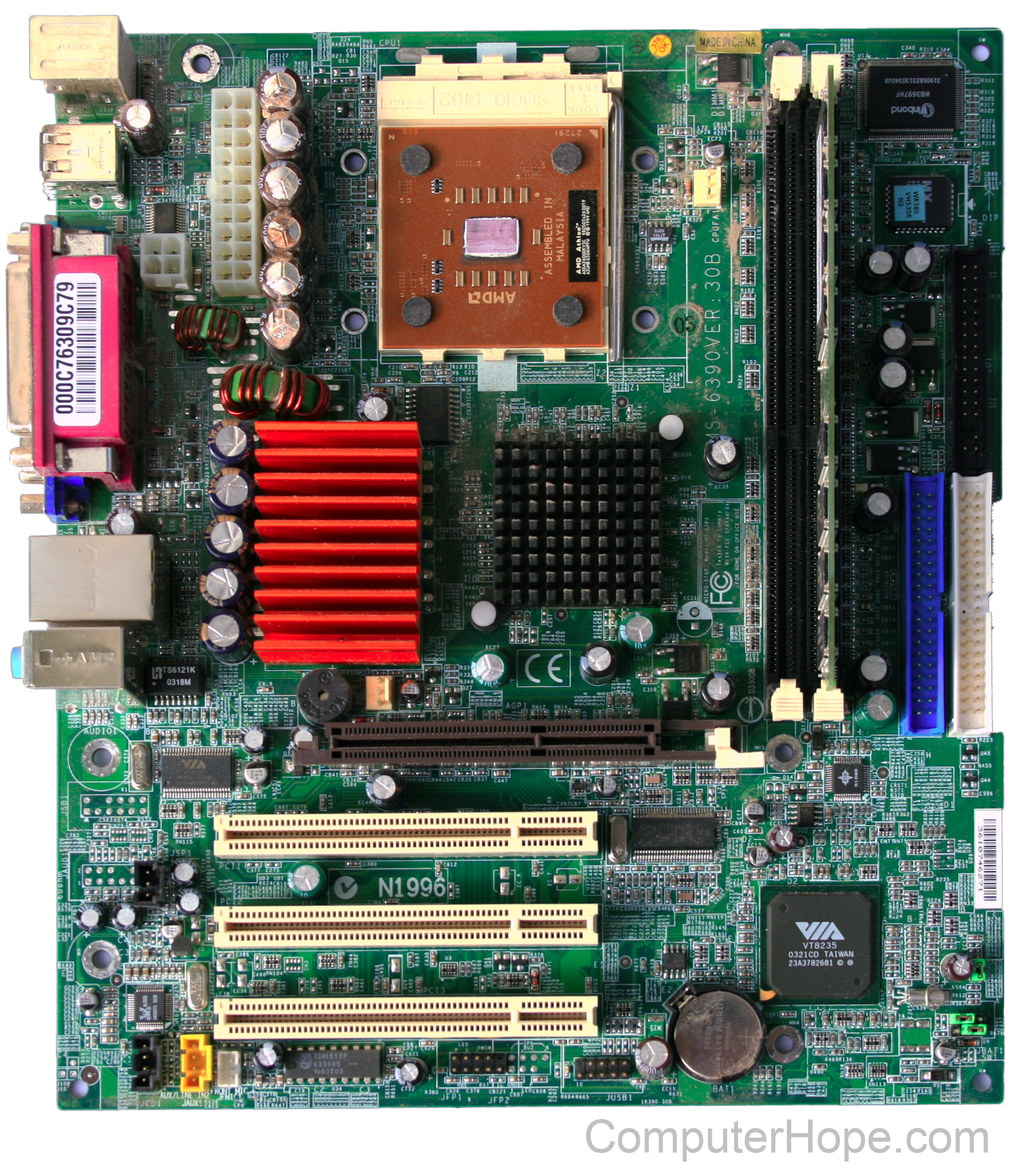
Alternatively called the mb, mainboard, mboard, mobo, mobd, backplane board, base board, main circuit board, planar board, system board, or a logic board on Apple computers. The motherboard is a printed circuit board and foundation of a computer that is the biggest board in a computer chassis. It allocates power and allows communication to and between the CPU (Central Processing Unit), RAM (Random-Access Memory), and all other computer hardware components.
Motherboard overview
A motherboard provides connectivity between the hardware components of a computer, like the processor (CPU), memory (RAM), hard drive, and video card. There are multiple types of motherboards, designed to fit different types and sizes of computers.
Each type of motherboard is designed to work with specific types of processors and memory, so they don't work with every processor and type of memory. However, hard drives are mostly universal and work with most motherboards, regardless of the type or brand.
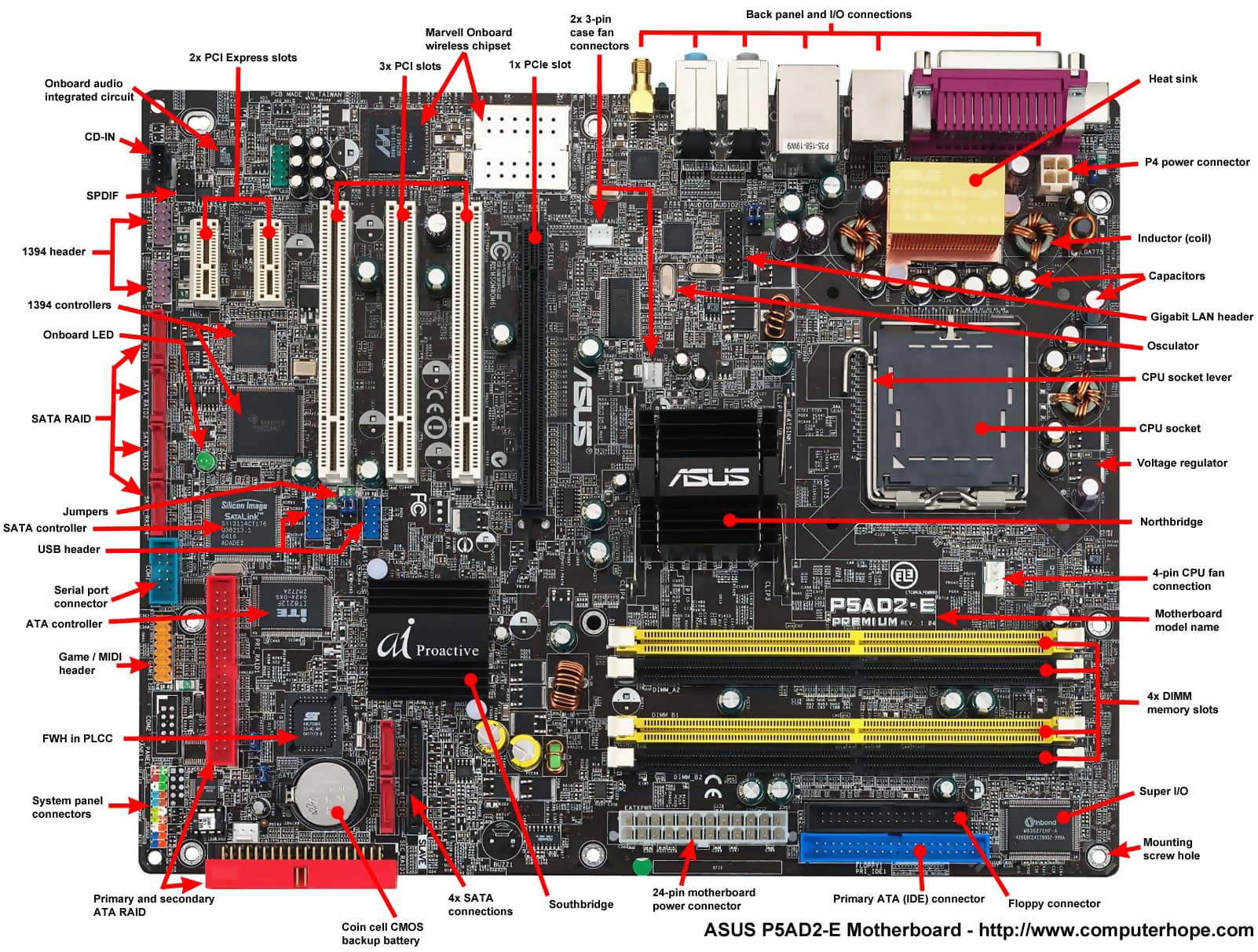
Below is a picture of the ASUS P5AD2-E motherboard with labels next to each of its major components. Clicking the image directs you to a larger and more detailed version.
Where is the motherboard located?
A computer motherboard is located inside the computer case and is where most of the parts and computer peripherals connect. With tower computers, the motherboard is on the left or right side of the tower and is the biggest circuit board.
Motherboard components
Below are links to pages with more details for each of the motherboard components mentioned in the previous section. The links are listed in clockwise order starting from the top-left corner of the image. Components not labeled on the image above are found in sections later on this page.
- Expansion slots (PCI Express, PCI, and AGP (Accelerated Graphics Port))
- 3-pin case fan connectors
- Back pane connectors
- Heat sink
- 4-pin (P4) power connector
- Inductor
- Capacitor
- CPU socket
- Northbridge
- Screw hole
- Memory slot
- Super I/O
- ATA/IDE disk drive primary connection
- 24-pin ATX power supply connector
- Serial ATA connections
- Coin cell battery (CMOS backup battery)
- RAID (Redundant Array of Independent Disks) interface
- System panel connectors
- FWH (FirmWare Hub)
- Southbridge
- Serial port connector
- USB (Universal Serial Bus) headers
- Jumpers
- Integrated circuit
- 1394 headers
- S/PDIF (Sony and Phillips Digital Interconnect Format)
- CD-IN
Older motherboard components
The following list contains links to components that are not shown in the picture above or were part of older computer motherboards.
- BIOS (Basic Input/Output System)
- Bus
- Cache memory
- Chipset
- Diode
- Dip switches
- Electrolytic
- Floppy connection
- Fuse
- Game port and MIDI (Musical Instrument Digital Interface) header.
- Internal speaker
- Keyboard controller
- LCC (Leadless Chip Carrier)
- Network header
- Obsolete expansion slots: AMR (Audio/Modem Riser), CNR (Communication and Network Riser), EISA (Extended ISA), ISA (Industry Standard Architecture), and VESA.
- Obsolete memory slots: SIMM (Single In-line Memory Module).
- Onboard LED (Light-Emitting Diode)
- Parallel port header
- PS/2 header
- Resistor
- RTC (Real-Time Clock)
- Serial port header
- SCSI (Small Computer System Interface)
- Solenoid
- Voltage regulator
- VRM (Voltage Regulator Module).
What cables are connected to the motherboard?
Cables that may connect to the motherboard include the following cables.
- 24-pin ATX power supply connector - The main power cable that connects the motherboard to the power supply.
- 4-pin (P4) power connector - Additional power cable for more modern processors.
- 3-pin case fan connectors - Small cable that supplies power from the motherboard to fans.
- SATA cable - Today's standard cable used to connect internal drives like SATA (Serial AT Attachment) hard drives to the computer.
- IDE cable - Older ribbon cable that connected IDE drives.
- Floppy cable - Floppy drive cable for older computers with floppy disk drives.
Motherboard form factors and types
As computers advanced, so have motherboards. Below are various motherboard form factors and additional information about each, including ATX, which is the most common.
- AT (advanced technology)
- ATX (Advanced Technology eXtended)
- Baby AT
- BTX (Balanced Technology eXtended)
- DTX
- LPX (Low Profile eXtension)
- Full AT
- Full ATX
- microATX
- NLX (New Low profile eXtended)
How many connections, ports, or slots are on a motherboard?
There's no set standard to how many connections, ports, or expansion slots are on a motherboard. The best method of determining how many connections, ports, or slots are available for your motherboard is to look up the specifications contained in its documentation. If you've lost or discarded your motherboard's documentation, you can often download a free PDF (Portable Document Format) version from the manufacturer's website.
Why are the slots and connections different colors?
The slots, ports, and connections on a motherboard may be color-coded to help identify the type of slot, port, or connector. For example, with our motherboard picture, the IDE (Integrated Drive Electronics) connectors are different colors to help identify the primary and secondary connectors. When the memory slots are different colors, it indicates the memory slots are dual-channel, and pairs of memory should be installed on the same channel (color). For example, in our picture, the yellow memory slots are Channel A, and Channel B are the black slots. If you were only installing two memory sticks, you'd want to install both of them in Channel A (yellow slots) for optimal performance.
See our color-coded page for information and examples of the color of the ports on the back of the motherboard.
How does a motherboard connect to a computer case?
A computer motherboard connects to a desktop computer case using standouts. Once the motherboard is attached to the case, all other devices connect to the motherboard itself or an expansion card.
What was the first motherboard?
The first motherboard is considered to be one used in the IBM Personal Computer, released in 1981. At the time, IBM called it a "planar" instead of a motherboard. The IBM Personal Computer and the motherboard inside it would set the standard for IBM-compatible computer hardware going forward.
Since there is a motherboard, is there a fatherboard?
No, there is no such thing as a fatherboard when referring to a computer. However, there is such a thing as a daughterboard.
Where did the motherboard get its name?
The daughterboards we mentioned in the previous section are circuit boards that all plug into one larger central circuit board; a motherboard. The smaller boards can be thought of as the main board's "children," hence the name motherboard.
Are Dell, HP, and other OEM motherboards different?
Yes, OEM (Original Equipment Manufacturer) motherboards from manufacturers like Dell and HP (Hewlett-Packard) are slightly different than other motherboards you'd find from a retailer. An OEM designs their motherboard for their needs for each model of computer. Some OEMs may even make drastic changes that go beyond the typical motherboard form factor. However, although an OEM motherboard may have it's differences, visually they often look similar. Also, if there hasn't been too many changes, it may be possible to replace the OEM motherboard with a retail motherboard. For OEM computers with differences, you'll need a replacement from the OEM or through a third-party that sells parts from used computers.
Is there a motherboard in a laptop, smartphone, and tablet?
Yes, although the board is often called a "logic board" and not a motherboard. The logic board is similar to a motherboard and operates the same way. However, because of size requirements with most logic boards, components like the processor and RAM (in tablets and smartphones) are soldered onto the board. Also, because many of these devices have no upgrade options, there are no slots or sockets like a traditional computer motherboard.
What is another common name for a motherboard?
1. CPU
2. Fatherboard
3. Main system
4. System board
ATX, Backplane, Board, Chipset, Cpu socket, Expansion slot, Form factor, Hardware terms, Mother, Motherboard terms, Northbridge, Southbridge, Standout